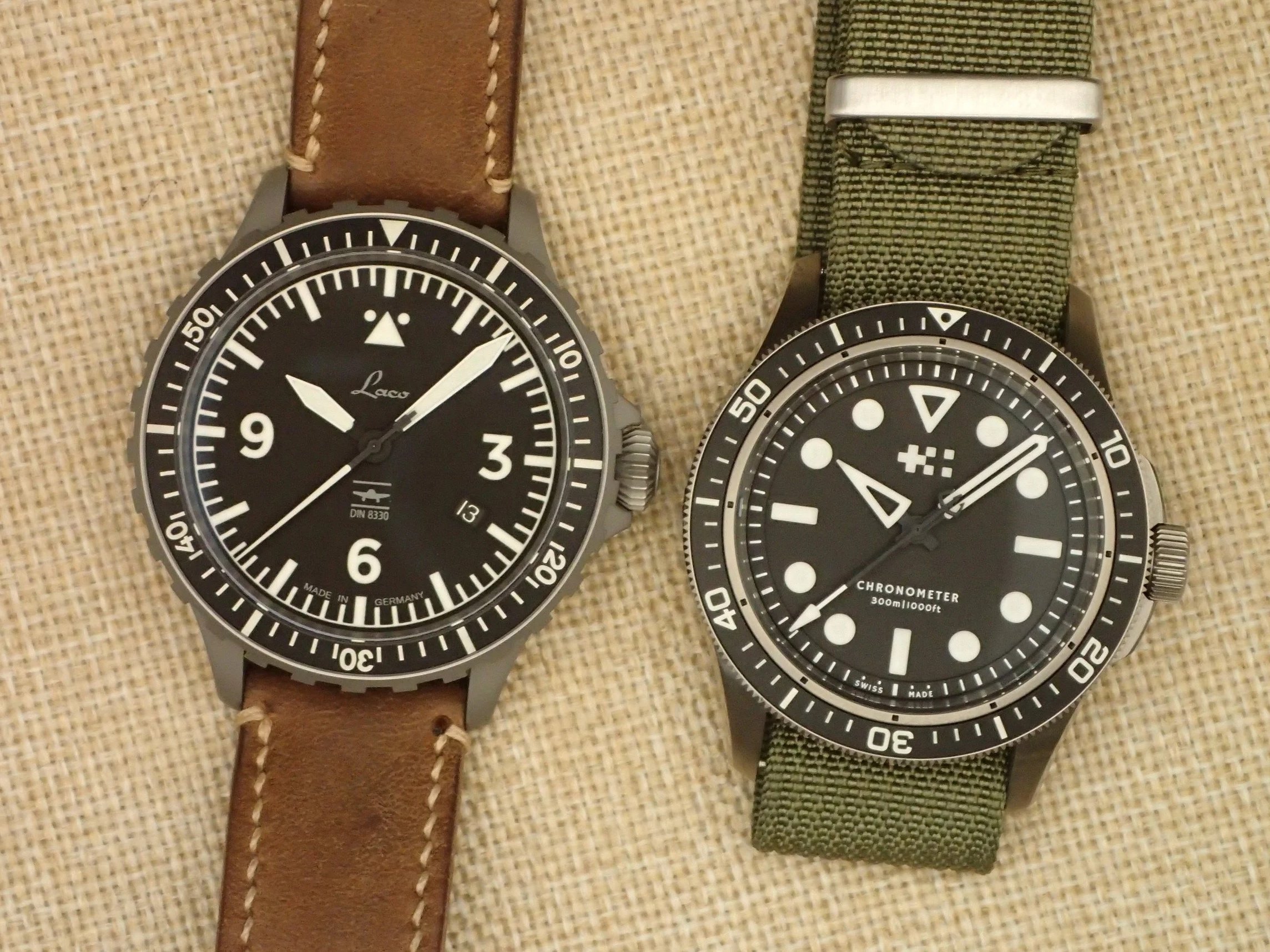
Head-to-Head Ultimate Tool Watch Challenge, the Laco Hamburg DIN 8330 and the Christopher Ward Green Fifteen.
Myron Erickson
Lately I’ve been in a pure tool watch mood. Following my nose like Toucan Sam follows his to the flavor of fruit, which is to say with no particular strategy, I’ve recently picked up two watches that are the ultimate specimens of their phenotype, the Laco Hamburg and the Christopher Ward Green Fifteen. Even though one is a “pilot’s” watch and the other a “diver’s” watch, and hence could be considered apples and oranges, in terms of the way they’re used on the wrist they have more in common than not.
The Deutsches Institut für Normung, DIN.
I’m neither a pilot nor a diver, but I appreciate that good standards are what keep our daily lives in order and hold entropy at bay. Most people don’t realize it, but many of the products we use everyday are the way they are because they comply to a standard of industrial uniformity. Germany was very early to figure this out, establishing the body that would become the Deutsches Institut für Normung way back in 1917. There are DIN standards for zillions of everyday things. The reason A4 paper is the size that it is? DIN 476. The reason you could replace the crappy radio that came in your car with something nice and know it would fit the hole in your dashboard? DIN 75490.
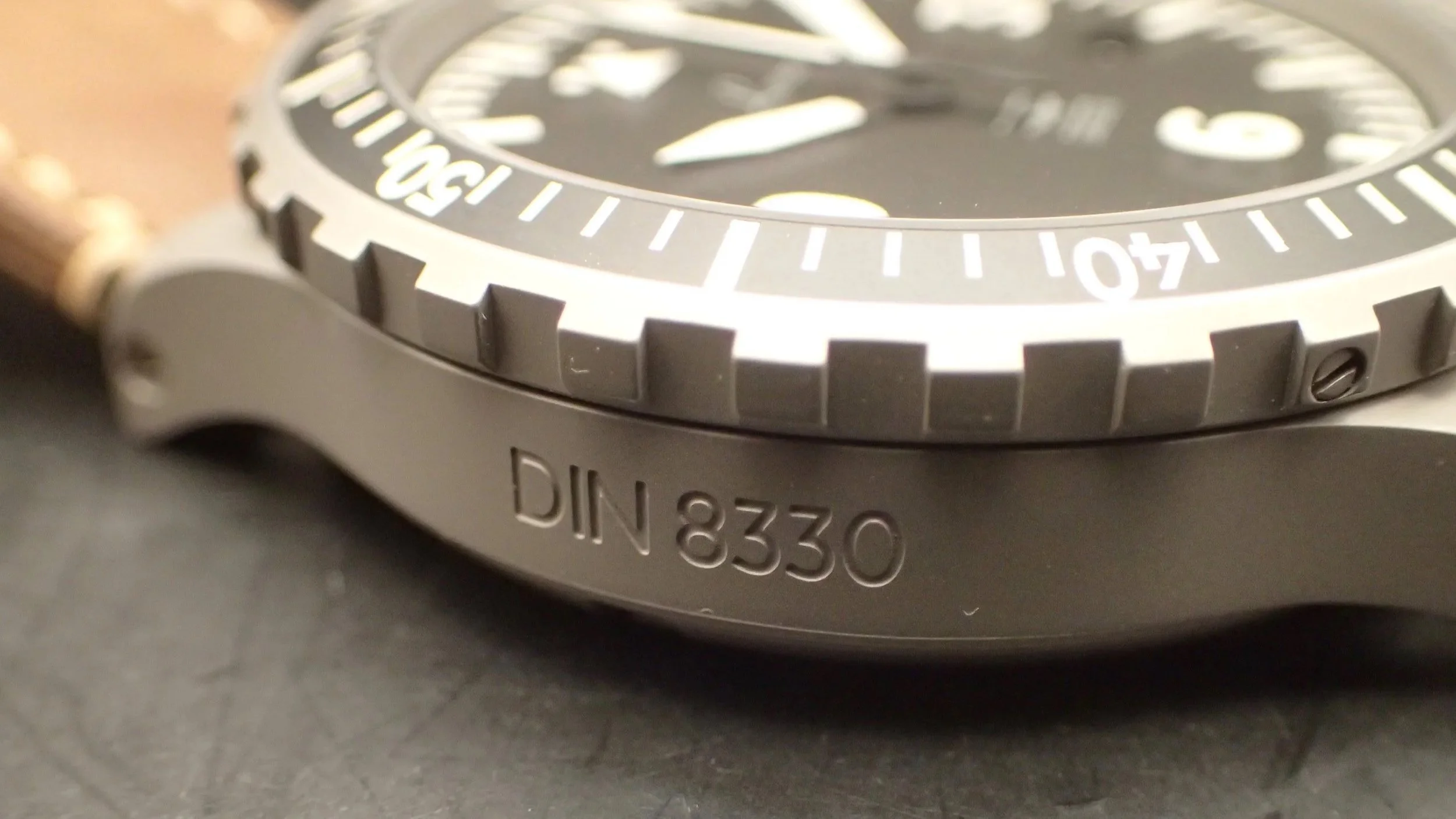
The Hamburg is DIN 8330 compliant, and Laco makes it hard to forget.
And so it is with watches. DIN 8330 defines a rigorous set of standards a pilot’s watch must meet if it is to fully replace the prescribed instruments for time measurement in an aircraft in case of emergency. And DIN 8306 is the set of standards a watch must meet to be legally labeled in Germany as a diver’s watch. DIN 8306 corresponds directly to the ISO standard many dive watch enthusiasts are familiar with, ISO 6425. But the DIN standard for chronometer accuracy, DIN 8319, is arguably more rigorous than Switzerland’s famed COSC standard, as it requires testing fully cased up watches, not just the uncased movements.

Things that aren’t “over-engineered” just because they are capable of more than you ask of them. Image credit: WZZM13, Wikipedia, Myron Erickson.
A pet peeve of mine is the term “over-engineered” in the context of tool watches and the way we typically use them. If you want or need a watch that meets strict performance standards because you are a professional pilot or diver, then DIN compliance will assure your watch will perform when it encounters those specified environments. While that watch may be over-spec’d for timing steaks on the grill, it is not over-engineered. If you are using your vintage Mickey Mouse watch to swim laps, like Robert Langdon does, then your watch is under-spec’d for the job, but it was perfectly engineered for its actual purpose, which was selling souvenirs to 10-year-olds at Disney Land.
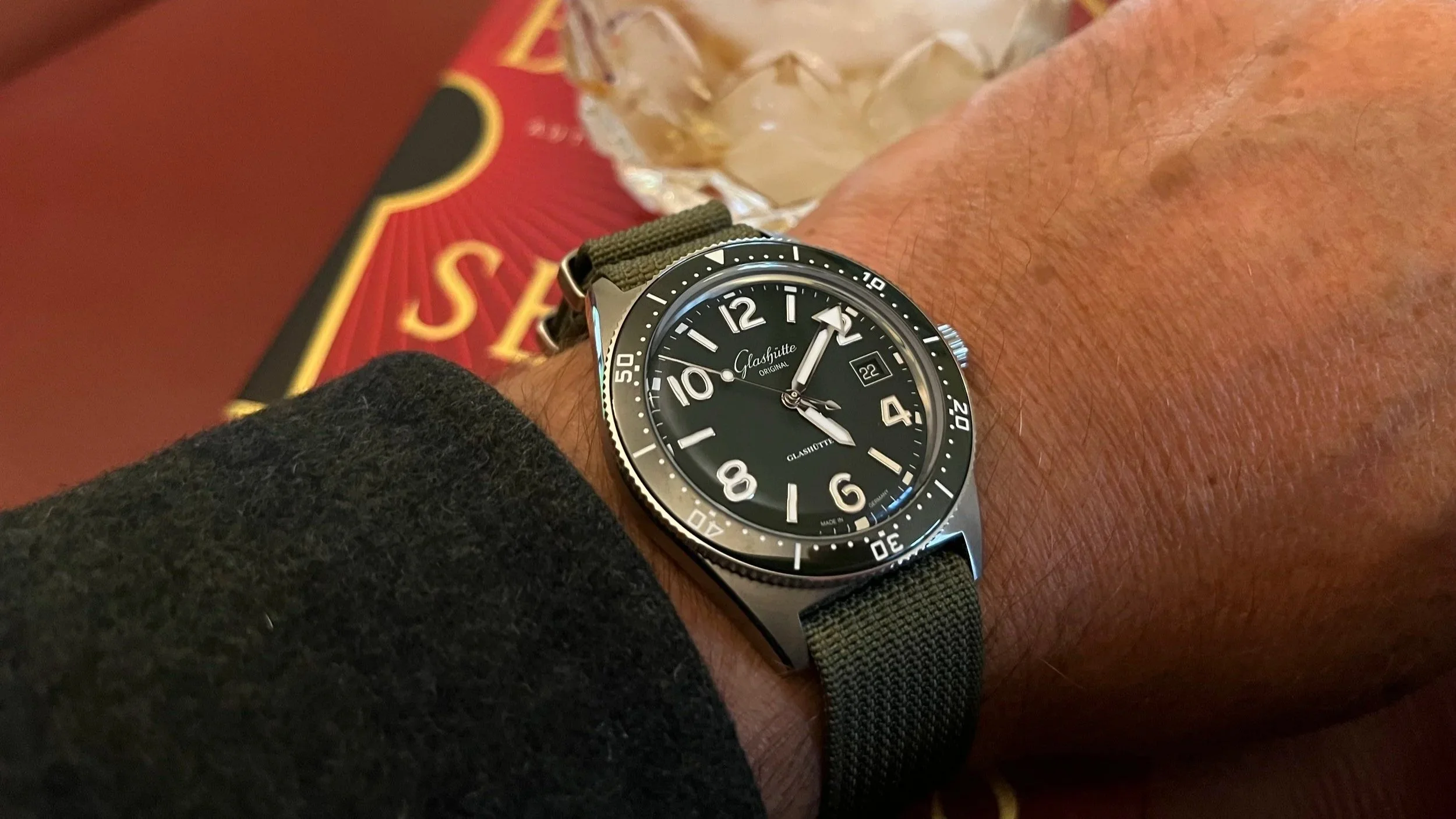
The Glashutte Original SeaQ is DIN 8306 certified. Would you call this watch “over-engineered”?
That’s enough about DIN standards and my pet peeves; let’s talk about these two beautifully designed and built watches.
The Laco Hamburg.
Among my favorite small, quirky German makers is Laco; I have almost always had one in my collection. But I had to admit I wasn’t wearing my Stuttgart PRO very often, and it didn’t take a session with Sigmund Freud to figure out why. Although my Laco possessed most of the mandatory tool watch characteristics — sturdy build quality, high legibility, good water resistance, exceptional lume — it lacked a timing bezel and I didn’t like the combination of manual wind movement and screw down crown. (Ok, that last part might need some psychoanalysis.) I’m not sure why, but living as we do in the Golden Age of Tool Watches, I decided I needed an upgrade.
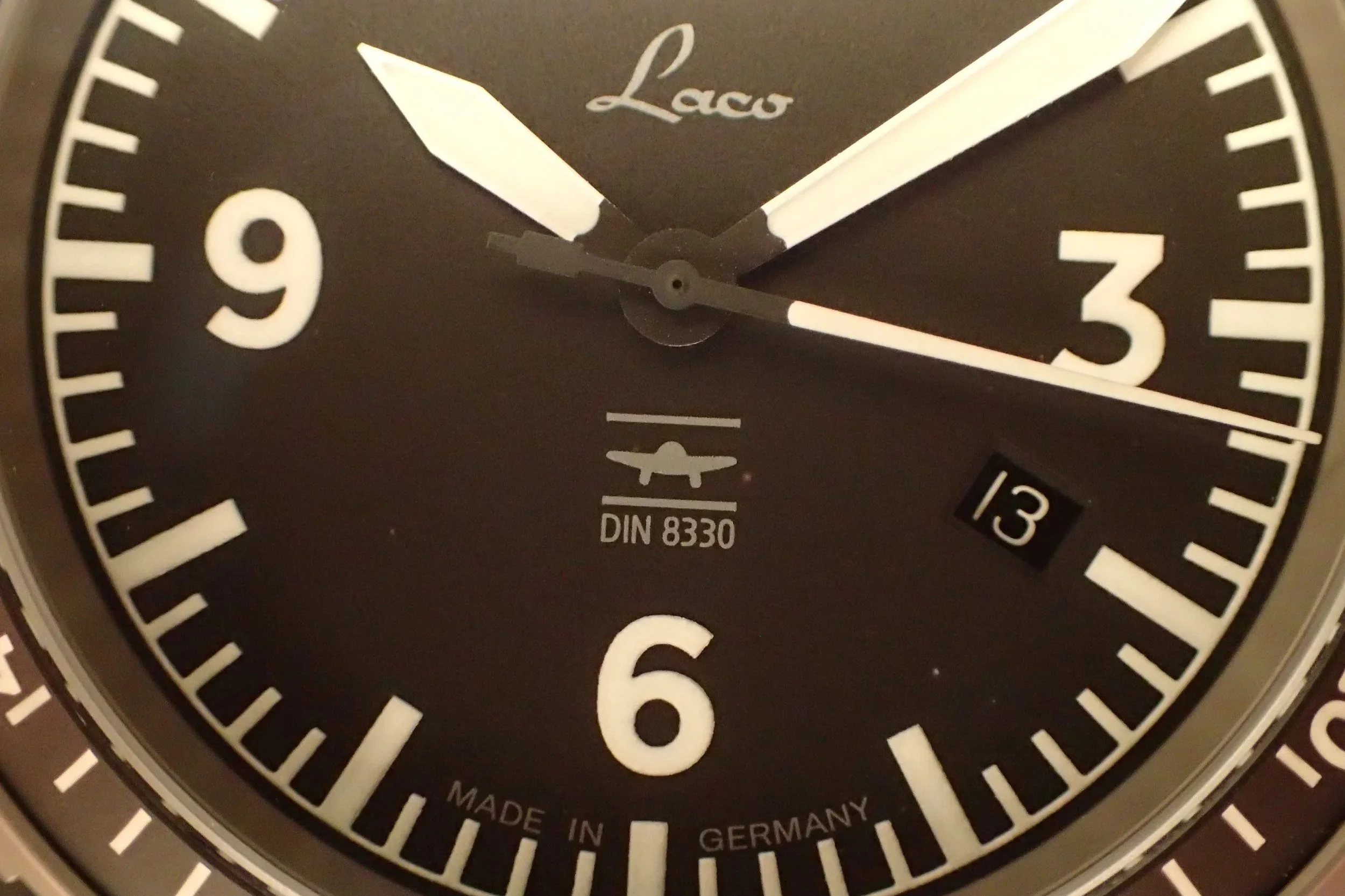
Dial details of the Laco Hamburg. The flat-topped 3 is amazing.
So I sold my Stuttgart PRO, but immediately lamented the Laco-sized hole in my collection. As I had lost track of the brand’s most recent developments, I hadn’t heard of either the Köln or the Hamburg. The Köln caught my eye first, a traditional baumeister A flieger with blued hands, but with the addition of an elapsed time bezel and oddly cool, Seiko-esque crown placement. It’s a bit of a platypus, the Köln, and while pondering this I stumbled across the Hamburg and was immediately smitten.
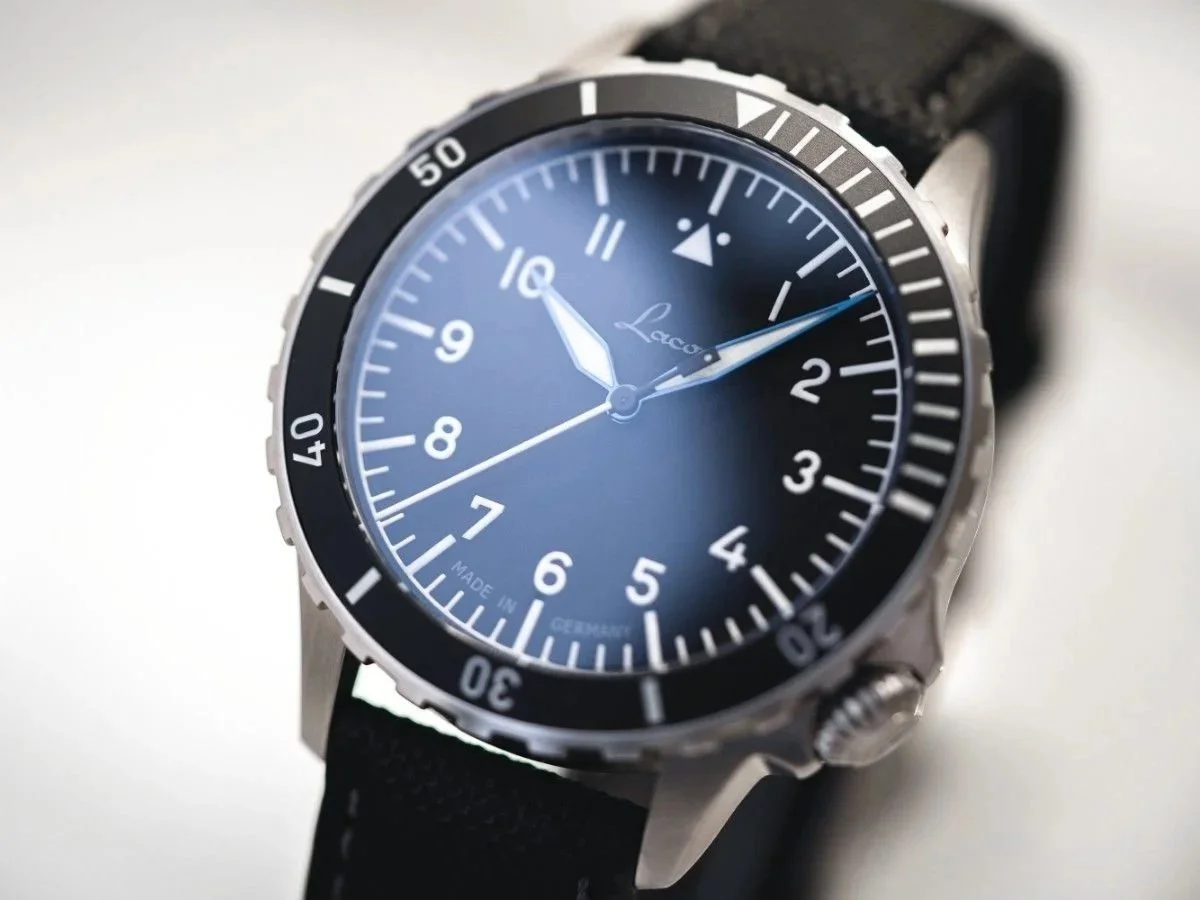
The platypus of fliegers, the Laco Köln. Image credit: Laco.
Laco takes no chances in you not noticing that they have gone to the effort to make the Hamburg a DIN 8330 compliant watch, as its full name is the Hamburg DIN 8330. If you’d like to read up on the rigorous tests a watch must pass before being certified DIN 8330 compliant, check out this article on Laco’s site. Even if you only wear dress watches and couldn’t give a single scintilla of a shit about engineering tests and standards, you will be impressed. And you might also want to check out Mainspring Watch Magazine’s great review of the Hamburg’s twin GMT sister.
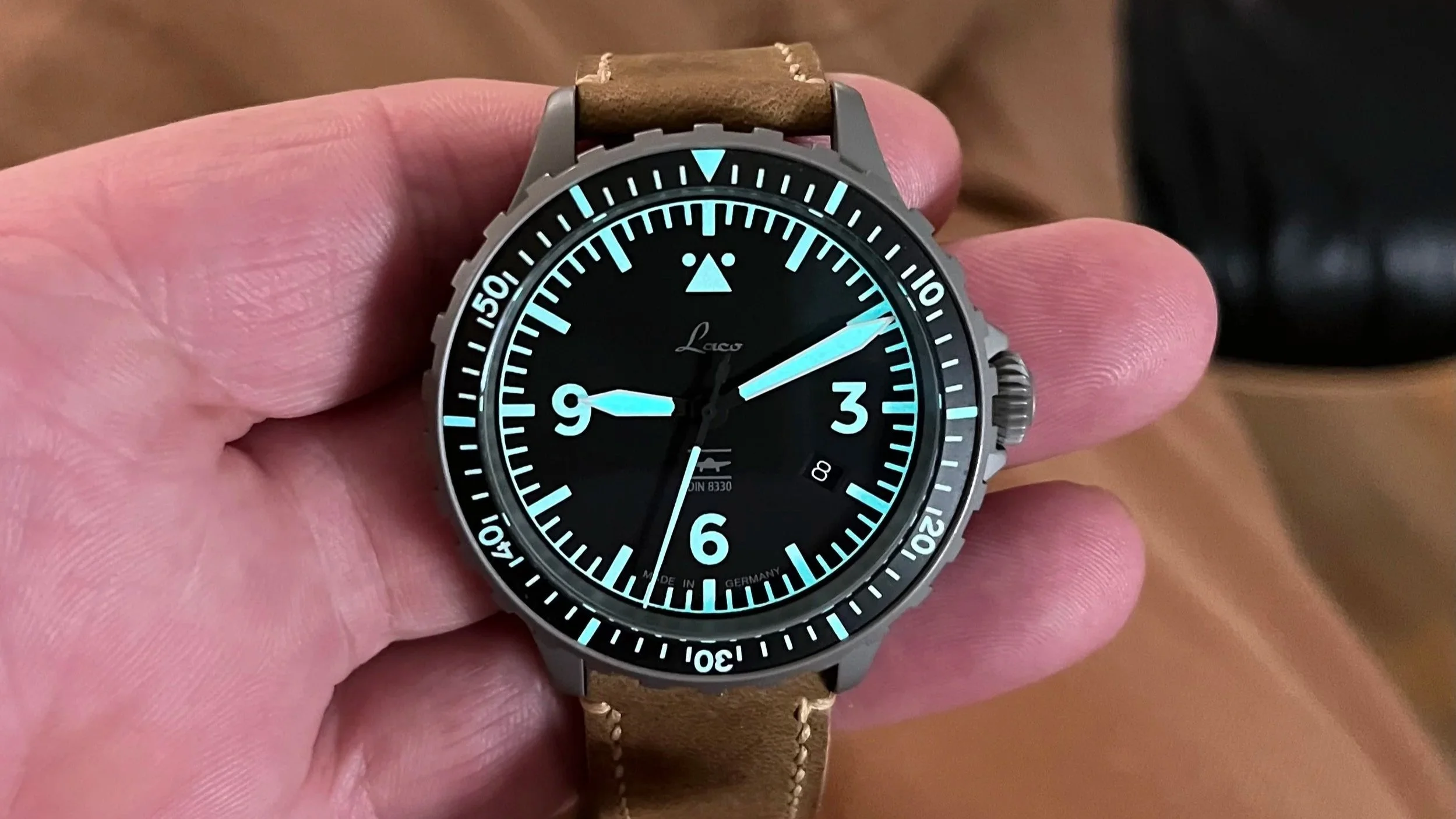
My most readable watch, the Laco Hamburg.
The Hamburg has a fully graduated and lumed elapsed time bezel, big beefy crown, and a dial and handset that look like a Sinn NaBo 17 cockpit clock had puppies with a FL 23883 beobachtungsuhr. If the flat-topped 3, the matte gray 904L stainless steel case, and the “DIN 8330” engraving were the hook, line, and sinker that Laco was dangling in front of me, then the DIN 8330 certification itself was the icing on my engineer nerd cake. With my metaphors thoroughly mixed, I could see that surely this was the Ultimate Tool Watch for me, my UTW.
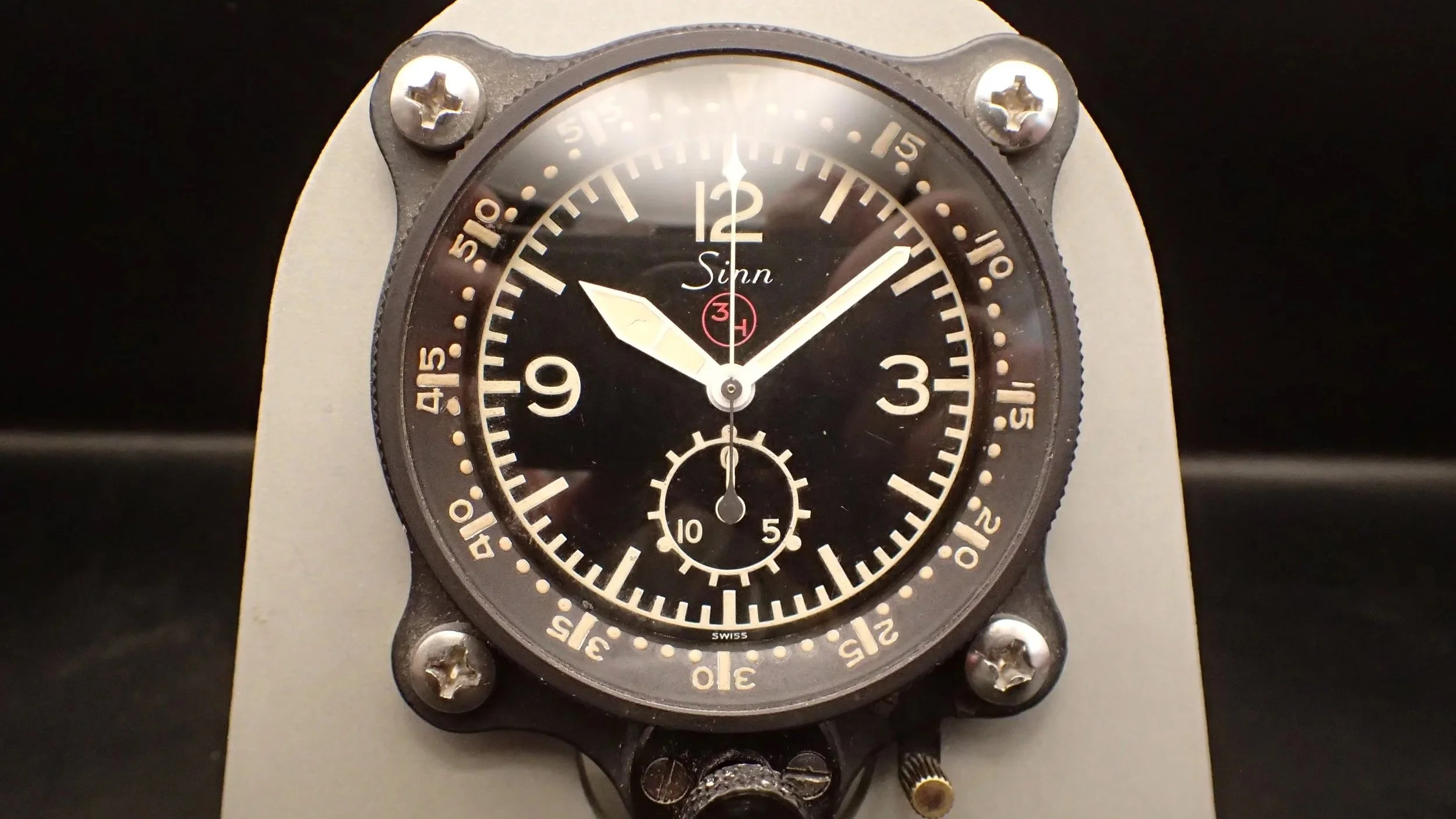
Look familiar? The Sinn NaBo 17 cockpit instrument clock.
The Christopher Ward Green Fifteen.
My Laco was delivered January 6th, and once again I was perfectly satisfied with my watch collection. Which lasted exactly one month, so close to a personal best. Because on February 5th wouldn’t you know it but Adrian Barker announced his collaboration with Christopher Ward, the Green Fifteen, which he described as taking an already great dive watch and turning it into his Ultimate Tool Watch. And damn it all if right there in his YouTube announcement of the project he didn’t feature and compare his UTW to a Land Rover Defender, and state, seemingly directly to me, that he derived design inspiration for said UTW from his grandfather’s vintage Victorinox Electrician. Sometimes you’re just damned-if-you-do because the damned-if-you-don’t option isn’t a realistic choice. After about 10 minutes and 10 seconds of thought (the length of Adrian’s video), I joined the order list.
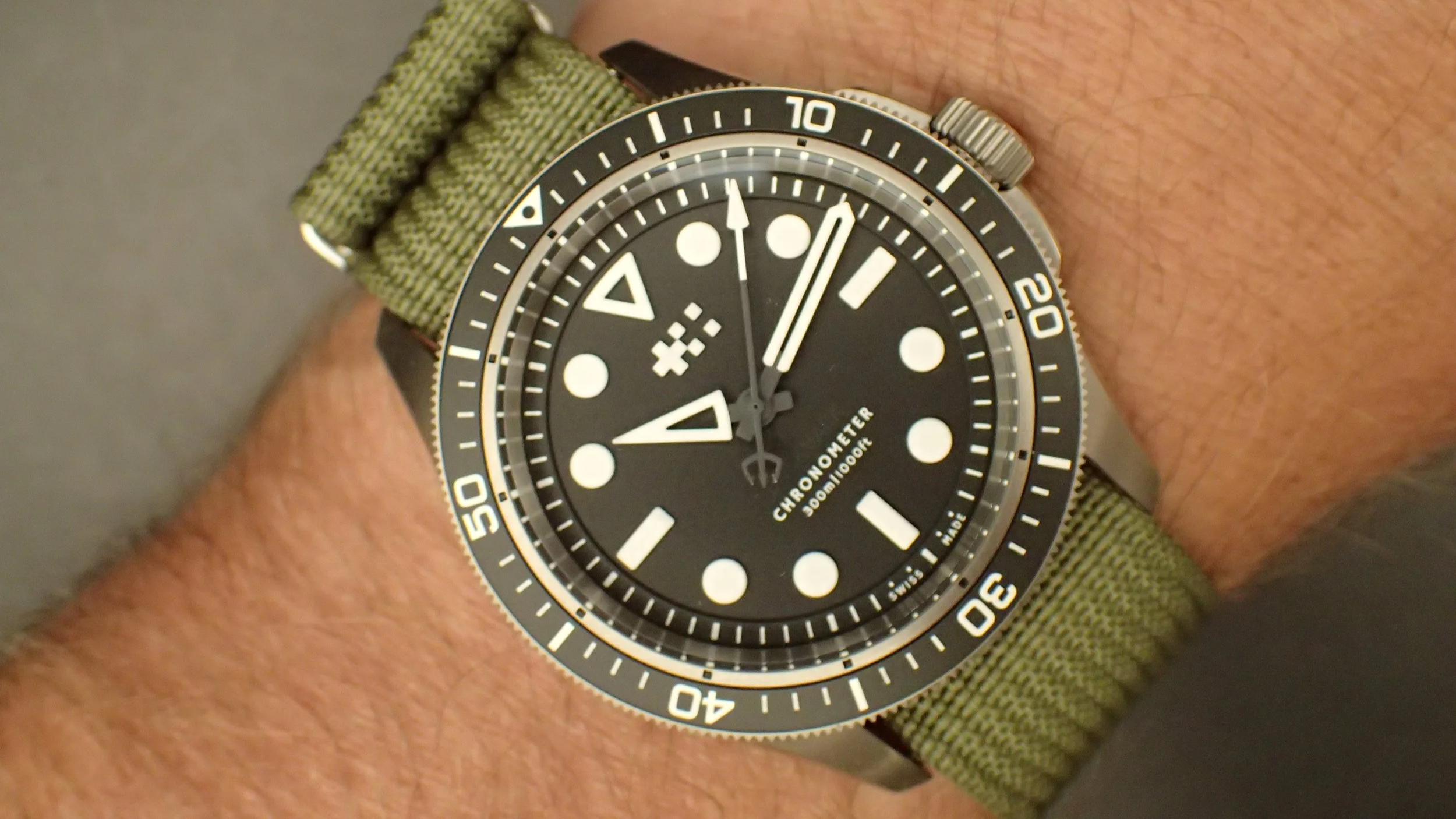
The Christopher Ward Green Fifteen.
I had been Christopher-Ward-curious for years, but had never owned one and was a little on the fence about the brand’s identity. It seemed like they needed some time to settle on a logo, for one thing, and figure out a recognizable design DNA for another. I was pondering the C65 Sandhurst, a watch that seemed like a great way to scratch the ever present itch for a vintage Smiths W10 or Hamilton 6BB, but I hadn’t made up my mind about the large triangle hour hand imposed on what is already an iconic design.
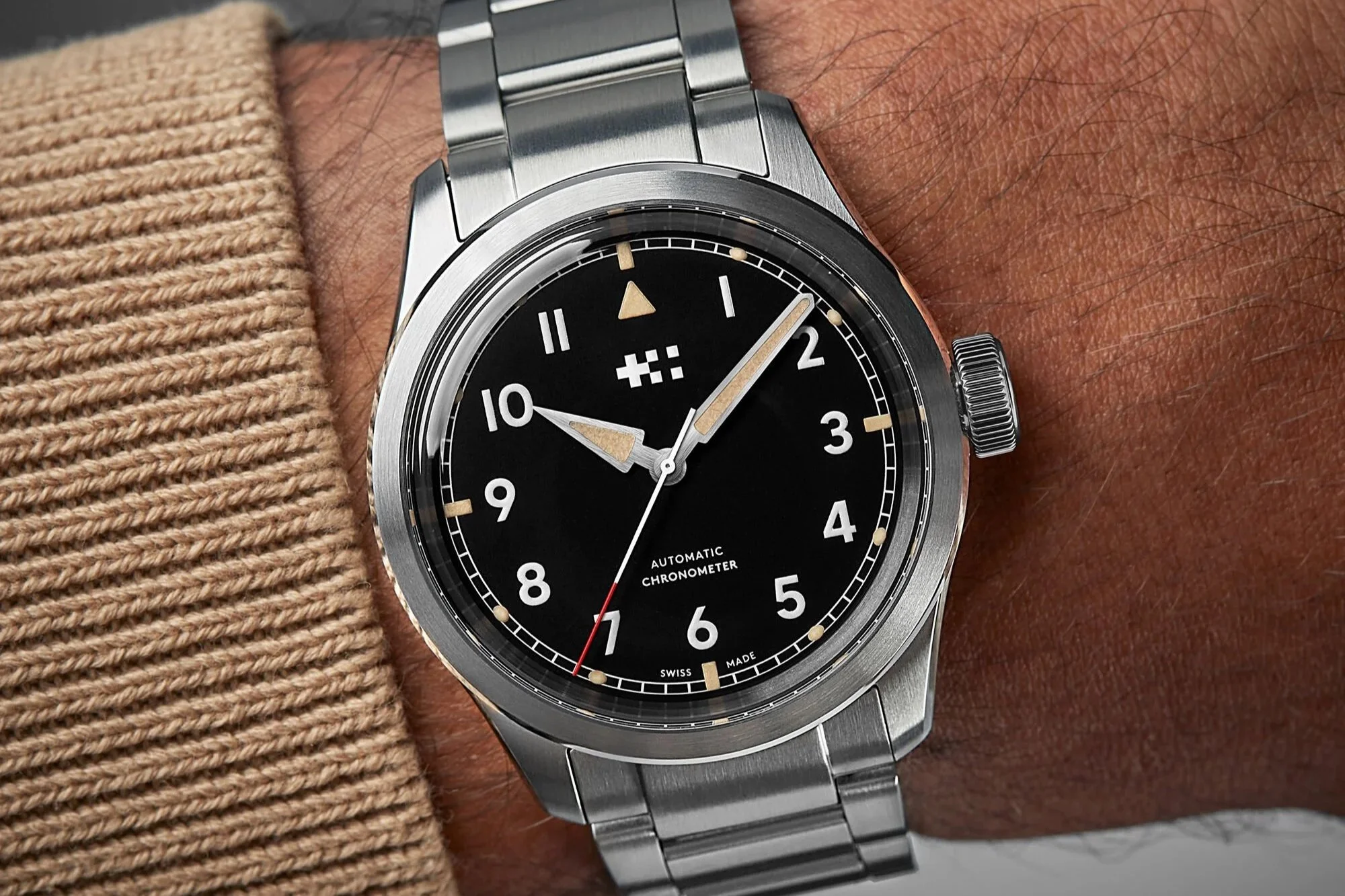
The Christopher Ward C65 Sandhurst 2. Image credit: Christopher Ward.
But when I saw the new logo and the triangle hour hand implemented on CW’s own design, the C60 Trident series of watches, something clicked in my brain and suddenly I was a Christopher Ward convert. The Green Fifteen started out as the Lumiére, CW’s 300m COSC-certified dive watch from the C60 Trident family that uses lume blocks (instead of luminous painted indices), skeletonized hands, and a titanium case. On Adrian Barker’s UTW version, the Lumiére’s lume block stick indices are changed to solid circles, the bezel is fully graduated and color-coded to the minute hand (hence the name of the watch), and the solid caseback gets the Victorinox Alox texture treatment. The final touch is the Bark & Jack name on the dial that is only visible when it fluoresces under UV light. Nice touch, that.
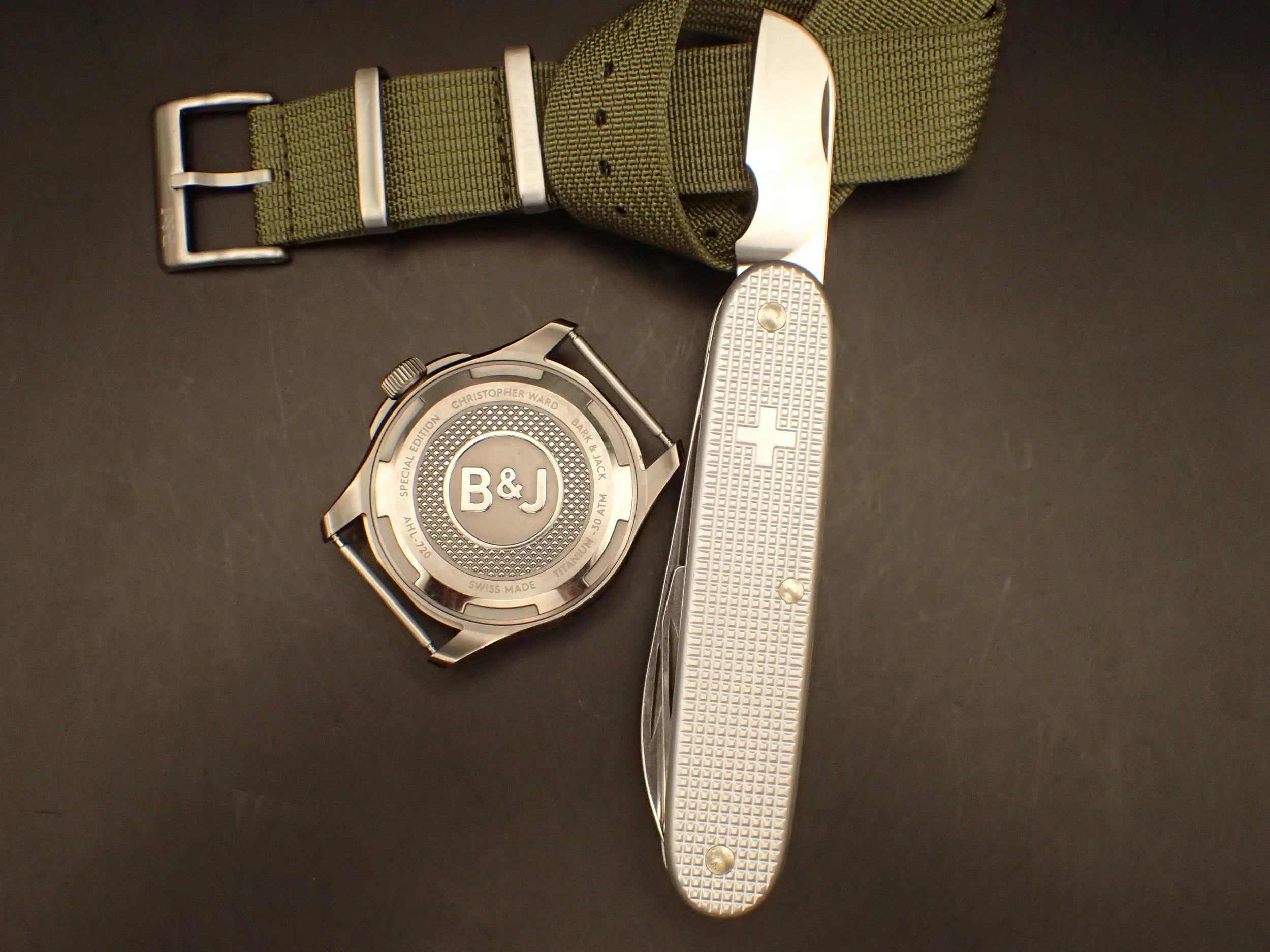
The caseback knurling inspired by a Victorinox Electrician.
Christopher Ward does not sell a DIN 8306 certified dive watch, but this is only because they don’t go through the certification process. The C60 Trident Lumiére meets or exceeds the strict standards described in DIN 8306, but CW can’t print “diver’s watch” on the dial and sell it in Germany without going through the (expensive) certification process. But there is no question that the Lumiére, and thus the Green Fifteen, meets or exceeds the DIN 8306 standards.
Living With the Laco Hamburg.
On paper and in person, the Laco Hamburg DIN 8330 is a big watch. If I hadn’t read a couple reviews that said it wears much smaller than its dimensions suggest, I don’t think I would have tried it. But Laco puts some kind of magical spell on the Hamburg that makes it wear much smaller in the metal — I would compare the wearing experience to a vintage Heuer 1550SG or its identical twin from Sinn, the 155. The 43.5 mm diameter, short lugs, and flat wearing experience combine with the 20 mm lug width to really conjure the classic Heuer Bund.
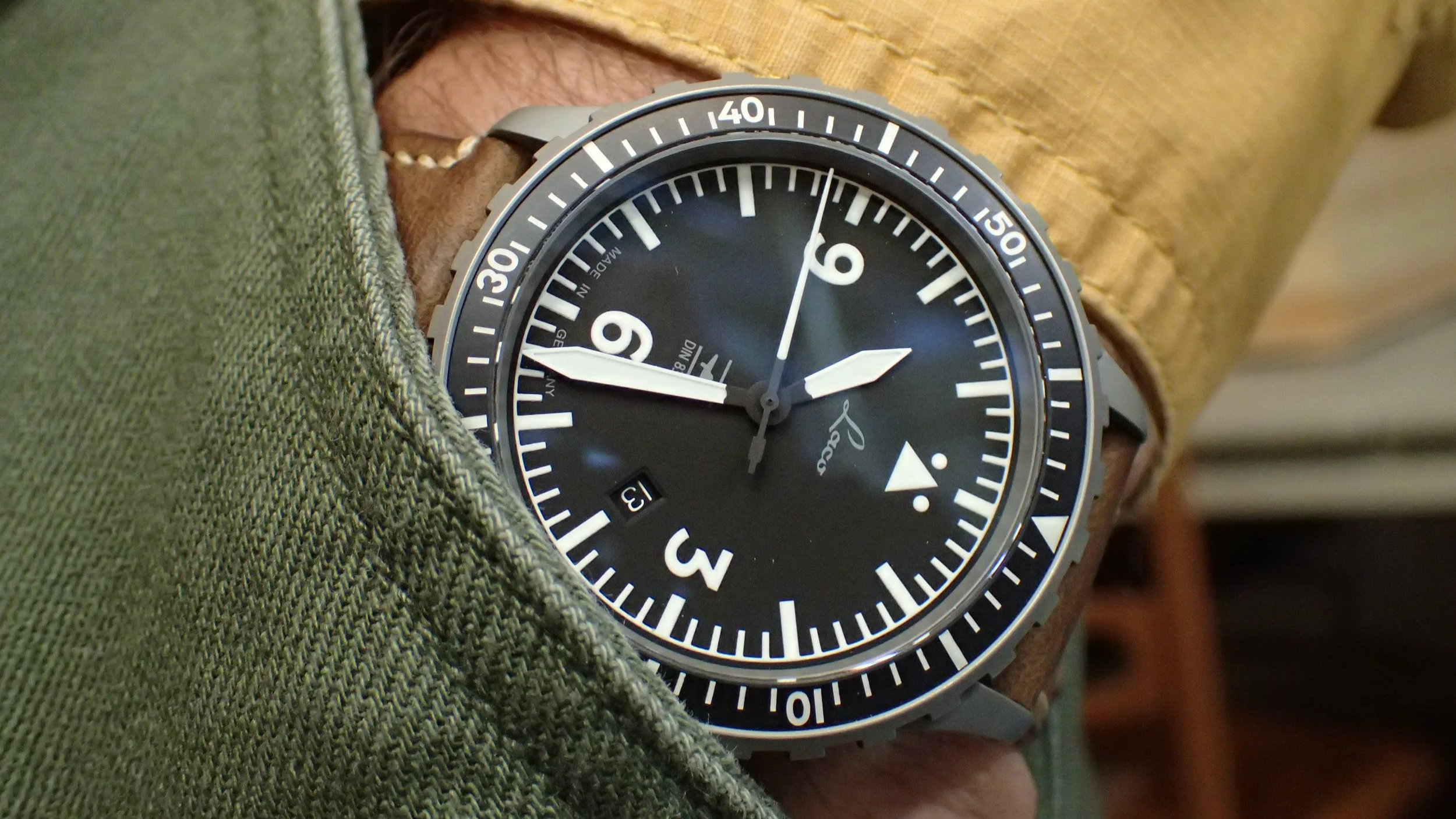
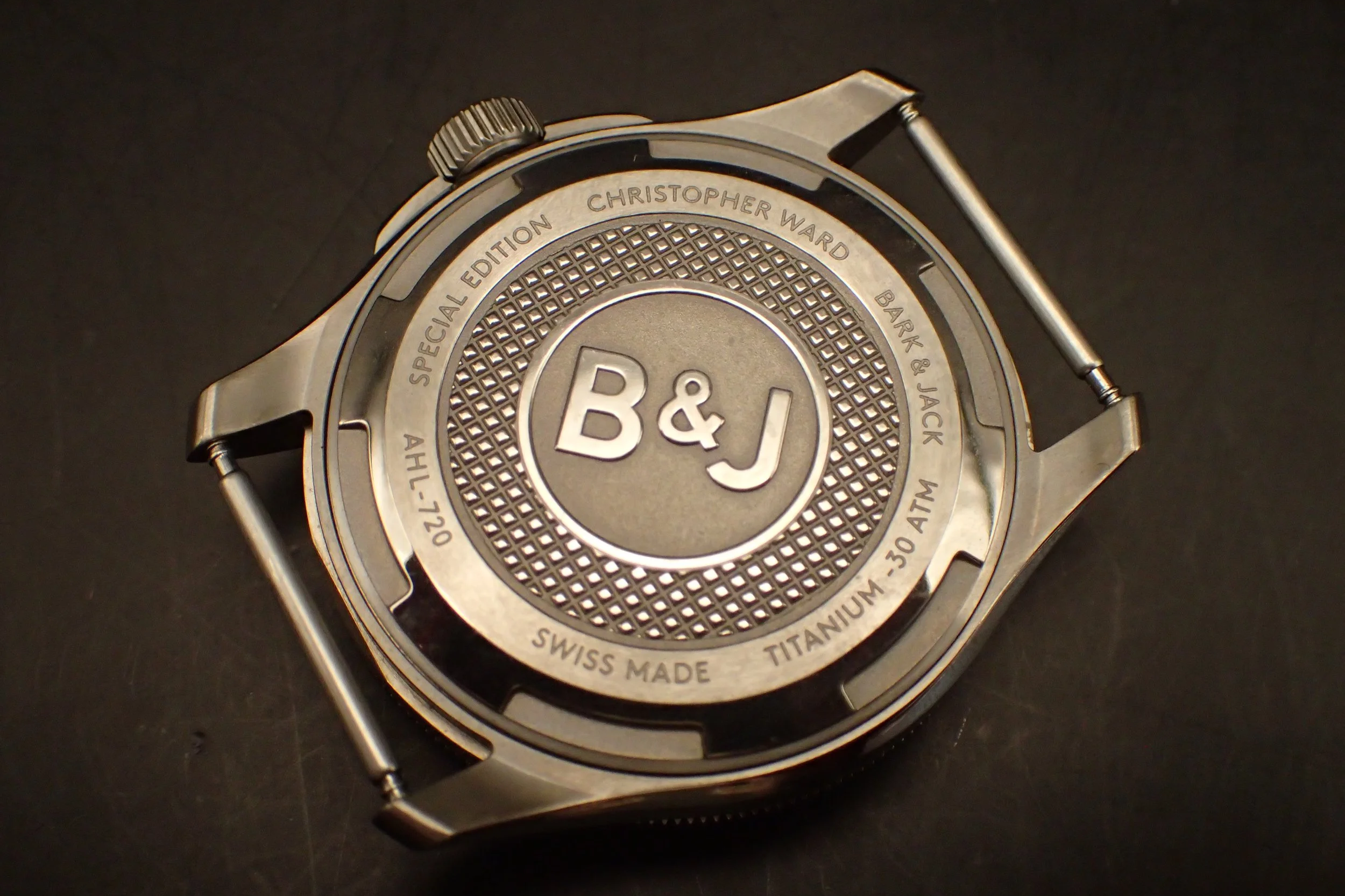
It bears repeating that this watch is made from 904L stainless steel, the same alloy that Rolex uses, which no doubt is critical to securing the DIN 8330 certification. But unlike Rolex, Laco media blasts the Hamburg’s case to a dull, dark, matte gray. It looks like the Parkerized case of the Hamilton FAPD 5101 from 1970, and lends an instrument look and feel to this watch. The subtle “DIN 8330” engraved on the side of the case evokes the FL 23883 specification from 1939, which is just such a nifty nod to Laco’s heritage and legacy. I love it.
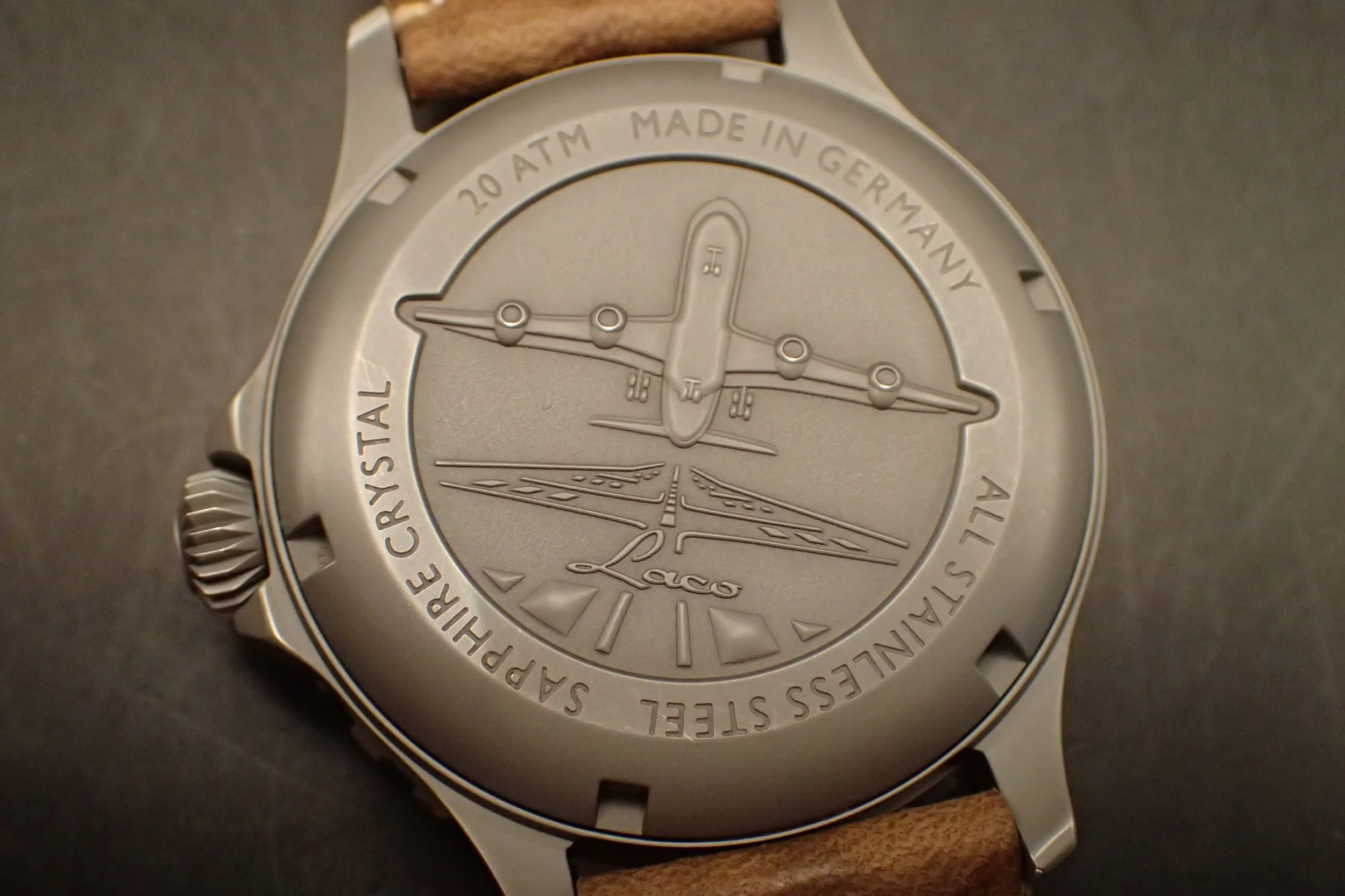
The Hamburg’s caseback showing off the dark matte finish of the 904L.
The bezel action is bidirectional and very smooth, positive, and certain. The bezel itself is captive, again minimizing the potential for disaster should you find yourself relying on this watch in the cockpit during an emergency. And, like the Green Fifteen’s, it is ceramic and fully lumed. The date window at 4 o’clock is small and subtle, there when you need it but disappearing when you don’t.
Like a good pilot’s watch, the Laco Hamburg wears really well on a leather strap. I keep mine on an inside-out shell cordovan strap that I made for it , and I won’t be changing it anytime soon. Good thing I love it, too, since strap changing is non-trivial with the Laco’s rather burly screwed strap bars. As the watch is a true keeper for me, I was a little worried about not having a spare set of strap bars, so I wrote to Laco and they sent me a pair for free with a lovely note.
The timekeeping on my Laco Hamburg has averaged +2 seconds per day when worn 24/7 for a week. Someday when it needs servicing my local guy will be able to work on the Sellita SW200-1 with no trouble. Honestly, when I try to think of things Laco could improve on this watch, I got nuthin’. I suppose they’d sell more units if it were 41 or 39 mm, but its Heuer Bund-like dimensions are perfect for me.
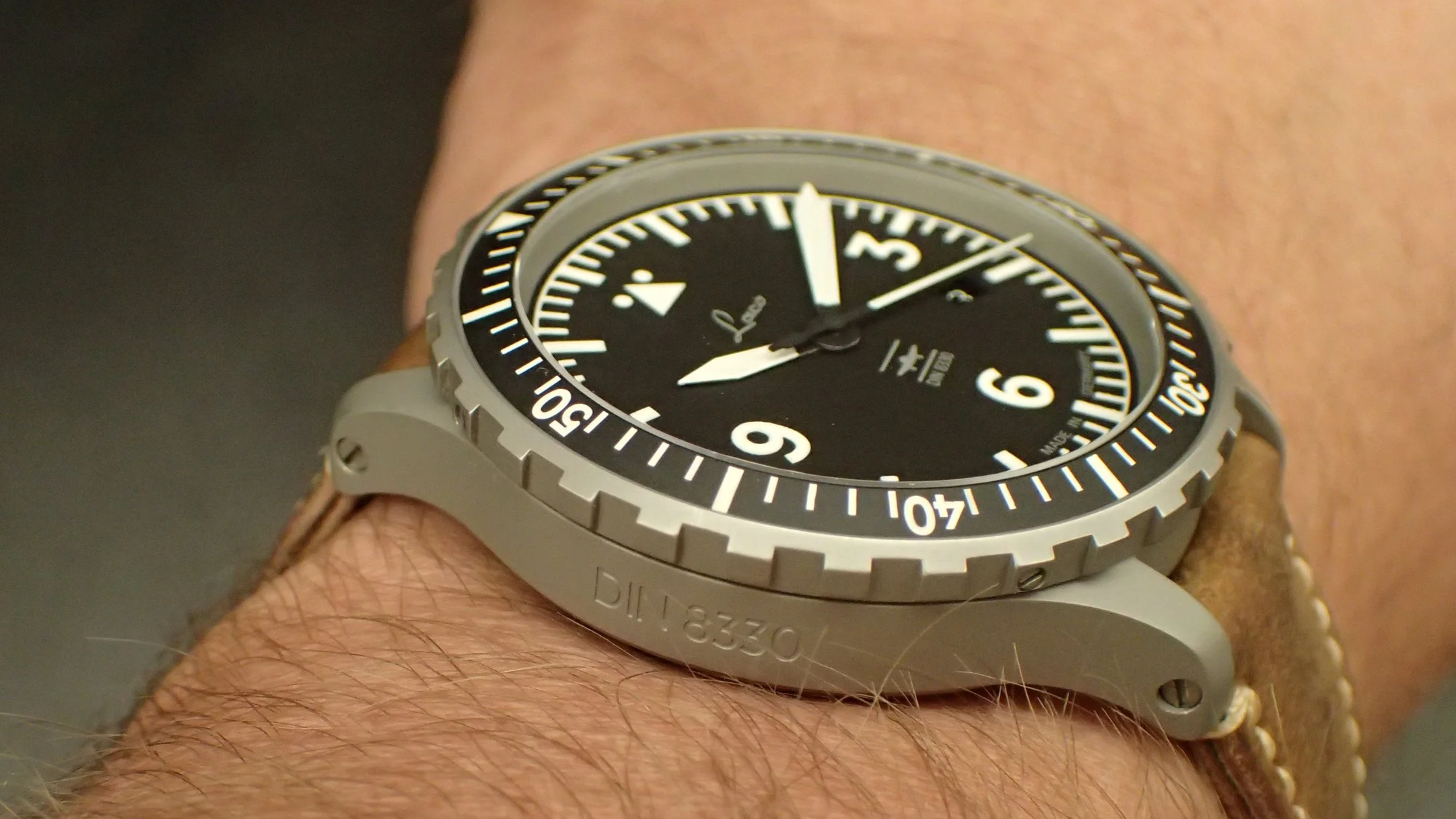
Hamburg on the wrist.
It’s a big watch that wears like a medium watch. It’s an excellent time keeper, has amazing lume, and wears perfectly on either your favorite leather or NATO strap. Its exotic stainless steel case will never wither or diminish. Take it flying, take it swimming, take it climbing, take it camping, take it to dinner. This watch has nothing you don’t need. It is the perfect Ultimate Tool Watch.
Living With the Green Fifteen.
The single most noticeable thing about the Green Fifteen is how incredibly not noticeable the watch is on your wrist. It is light; it is thin; it disappears. Maybe you can, but I can’t name another 300 meter diver that is less than or equal to 10.8 mm in thickness. Even the Tudor Black Bay 58, that darling of retro-darling dive watches, is 11.7 mm thick. With its 41 mm case diameter, svelte midriff, and titanium case construction, the Green Fifteen is perfect for just about every wrist.
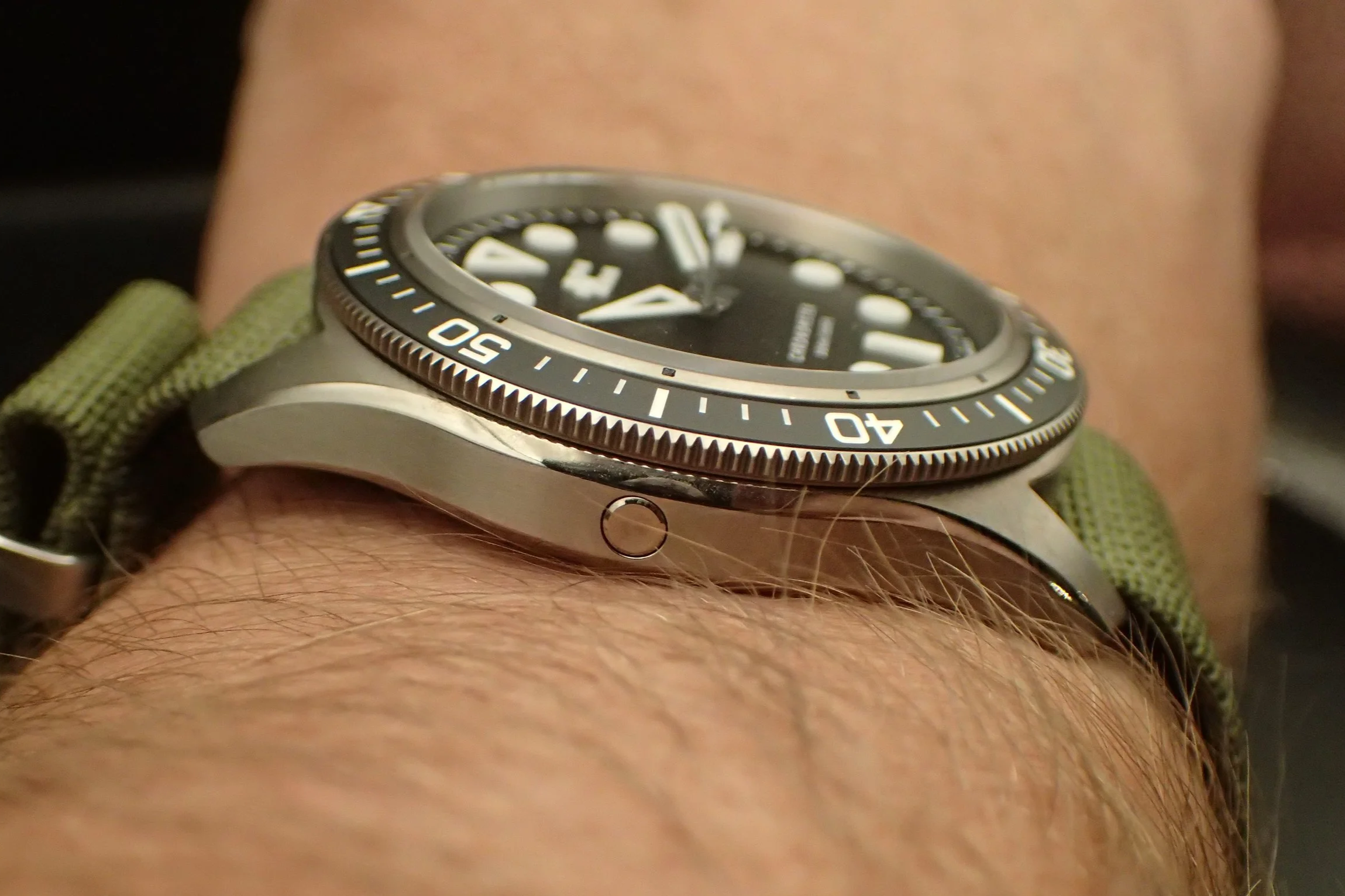
The Green Fifteen on the wrist.
The watch wears very nicely on its solidly constructed and easily adjusted bracelet, which itself is equipped with quick release spring bars, making changing out to a nylon NATO a breeze. And unlike some chunkier dive watches in my collection (ahem, Sinn 613 and Omega PO 2209), the Green Fifteen doesn’t need a bracelet to serve as counterweight. Go ahead, put it on a flimsy nylon NATO and get it wet — the ultra lightweight CW doesn’t care. And better yet, you can make this strap transformation when drunk using tools no more sophisticated than your finger nails (please don’t ask me how I know this).
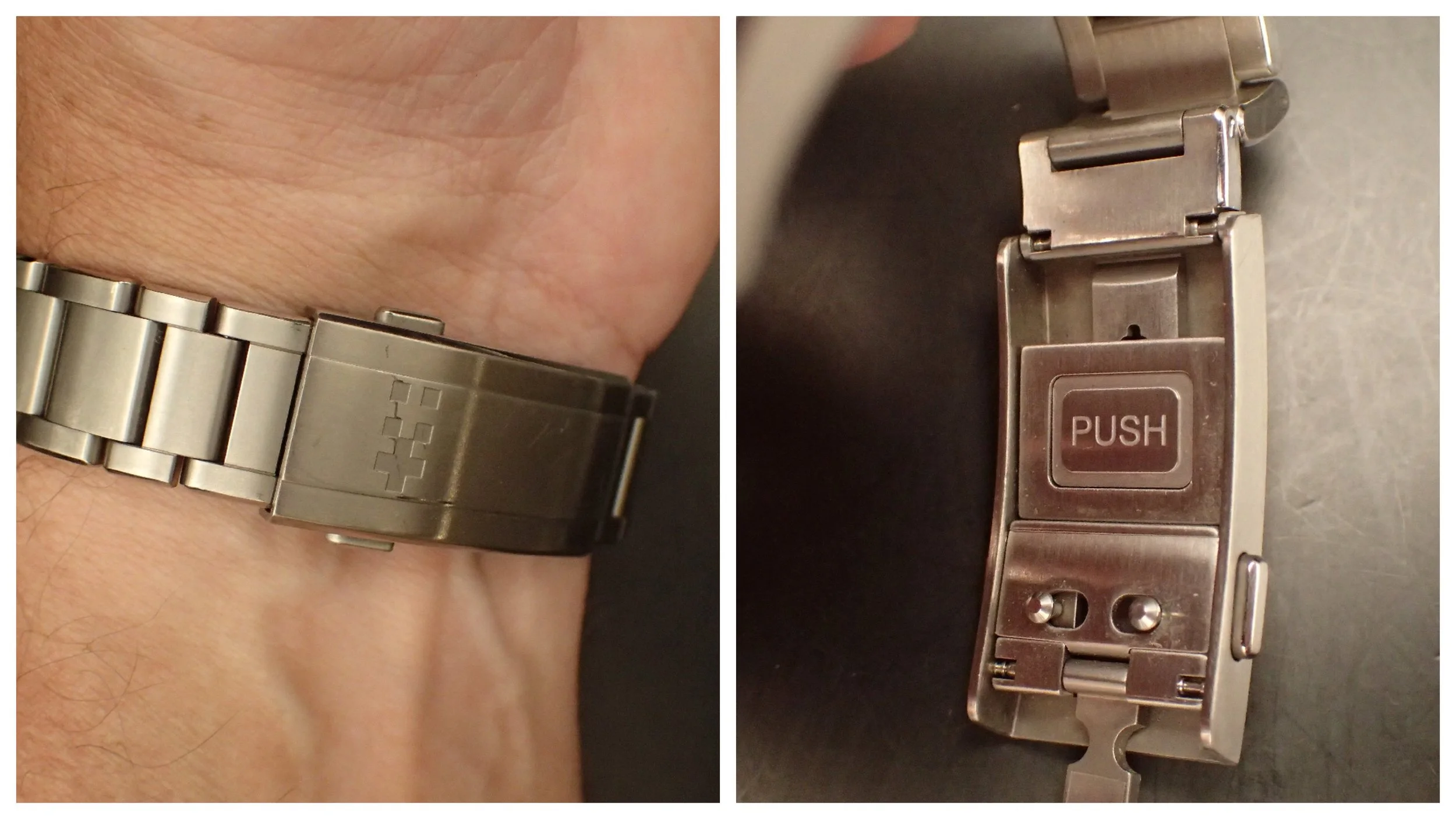
Nicely tapered and adjustable.
The light gray brushed titanium case with one single polished accent and signed crown looks dynamite. The dial, markers, and handset are very professional, but still manage to be fresh and modern and unlike anything else. The SW300-1 movement is COSC chronometer certified; mine kept time to within +3 seconds per day when worn on my wrist 24/7 for a week. The Green Fifteen is yet another watch you can take swimming, adventuring, sailing, interviewing, or to meet your girlfriend’s parents. It will do it all with ease and class and aplomb and zero asshole factor.
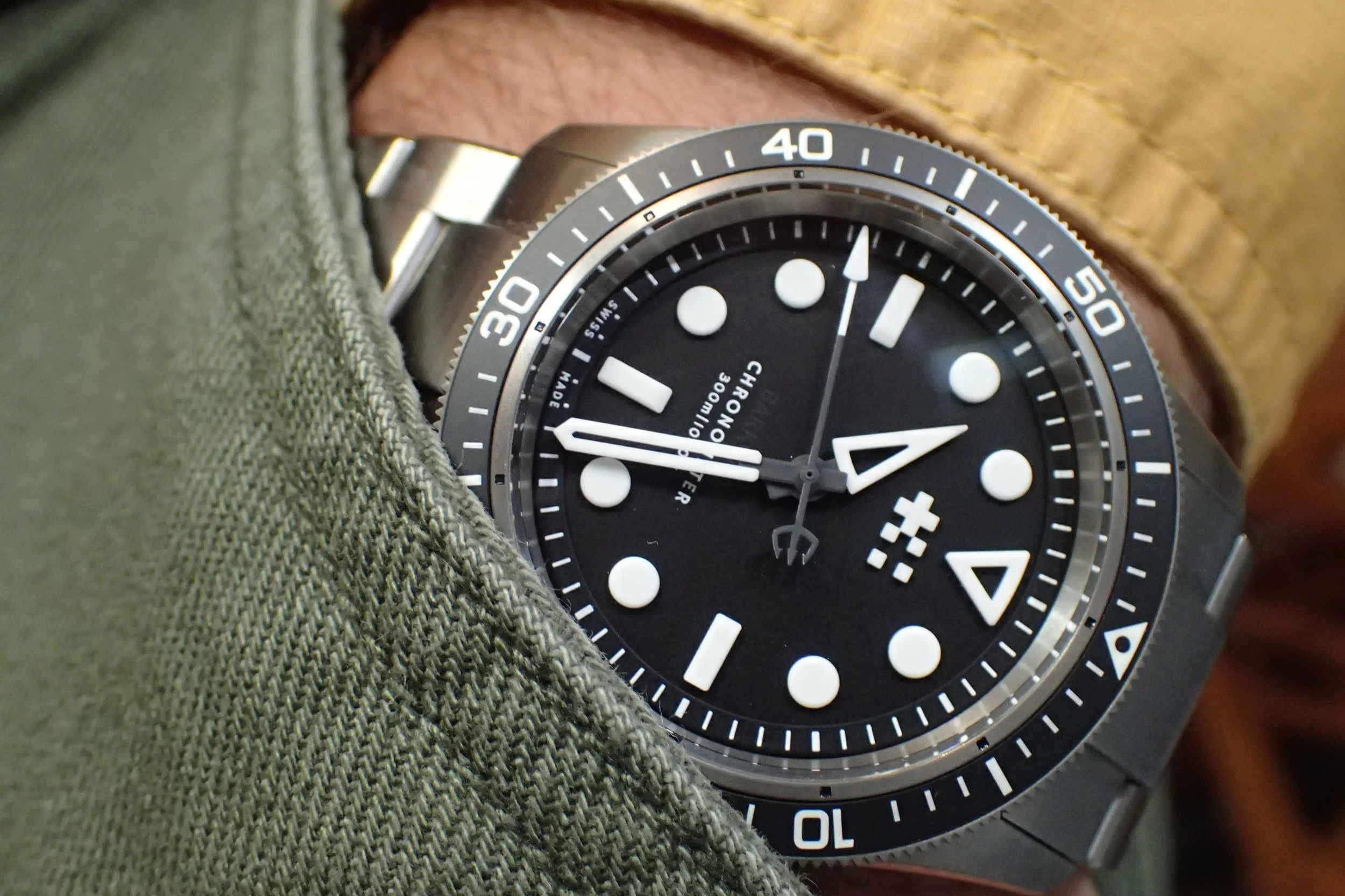
The Green Fifteen.
I have only two very minor criticisms of the Green Fifteen. One is the silly, unnecessary helium release valve. Please, Mr Ward, may I call you Chris? Haven’t we all learned from the Planet Ocean? I mean, I guess it demonstrates that the watch is a “professional” tool, but on the other hand an HRV is not required by the DIN 8306 standard and I cannot imagine that even 0.00001% of your customers are taking the Lumiére saturation diving. I guess the saving grace here is that at least the Lumiére’s HRV is the passive variety that’s mounted flush with the side of the case, and not the clunky extra crown variety. But still.
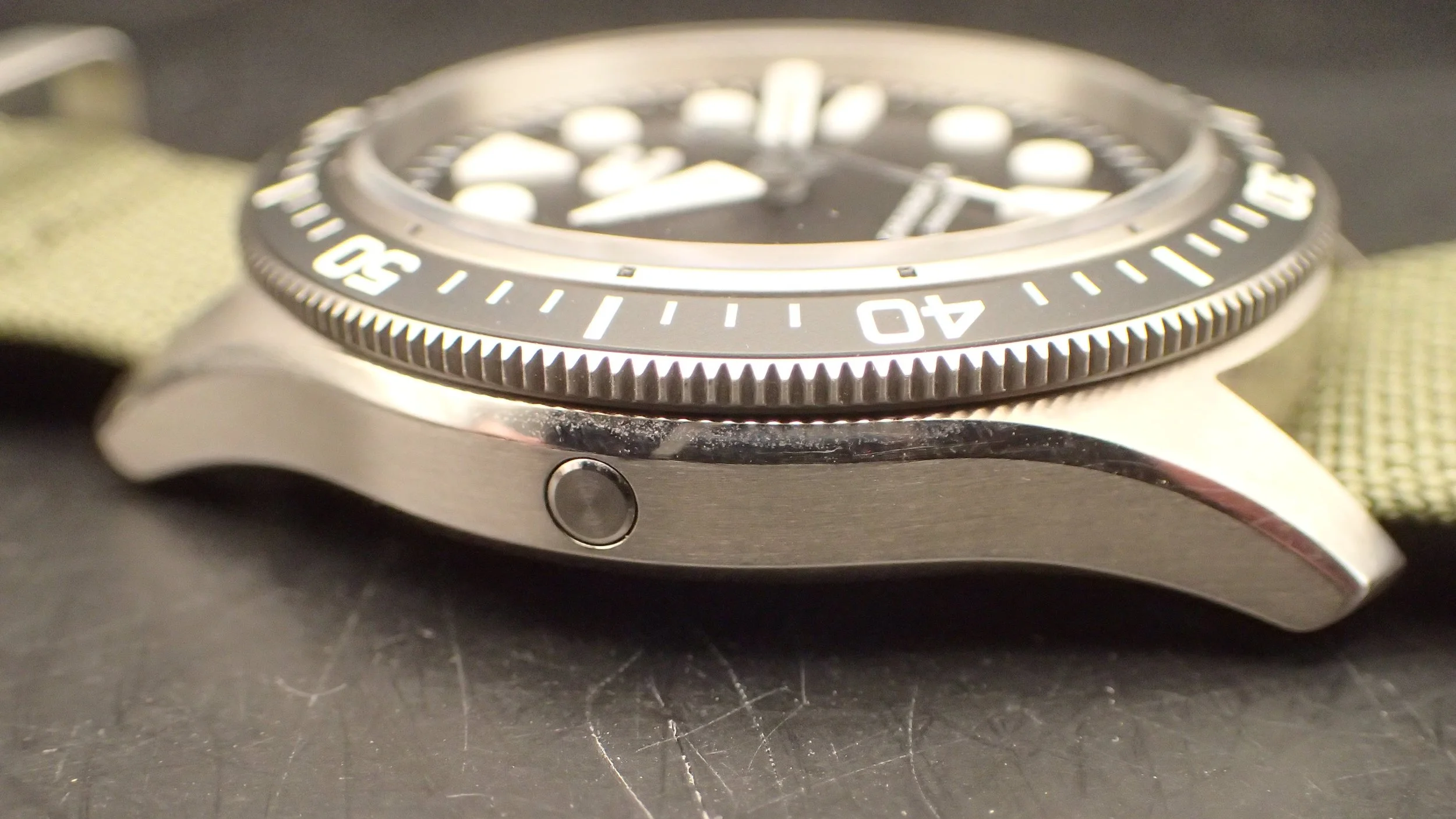
If you inhale from this while ascending, your voice gets really funny.
My second very minor gripe with the Green Fifteen is the crown guards, which appear to be screwed onto the case. The only other watch I know of with screwed-on flank protection is a Union Glashütte, and I’ve always thought that was silly too. Maybe it’s not possible to form titanium precisely enough to include crown guards? Maybe Chr. Ward treats this as a wear part and replaces the crown guards at service time? I asked Google Gemini why Chr. Ward might build the case this way and it said that doing so “combined distinct design and manufacturing advantages,” which sounds like A.I. bullshit to me. If you know, please share.
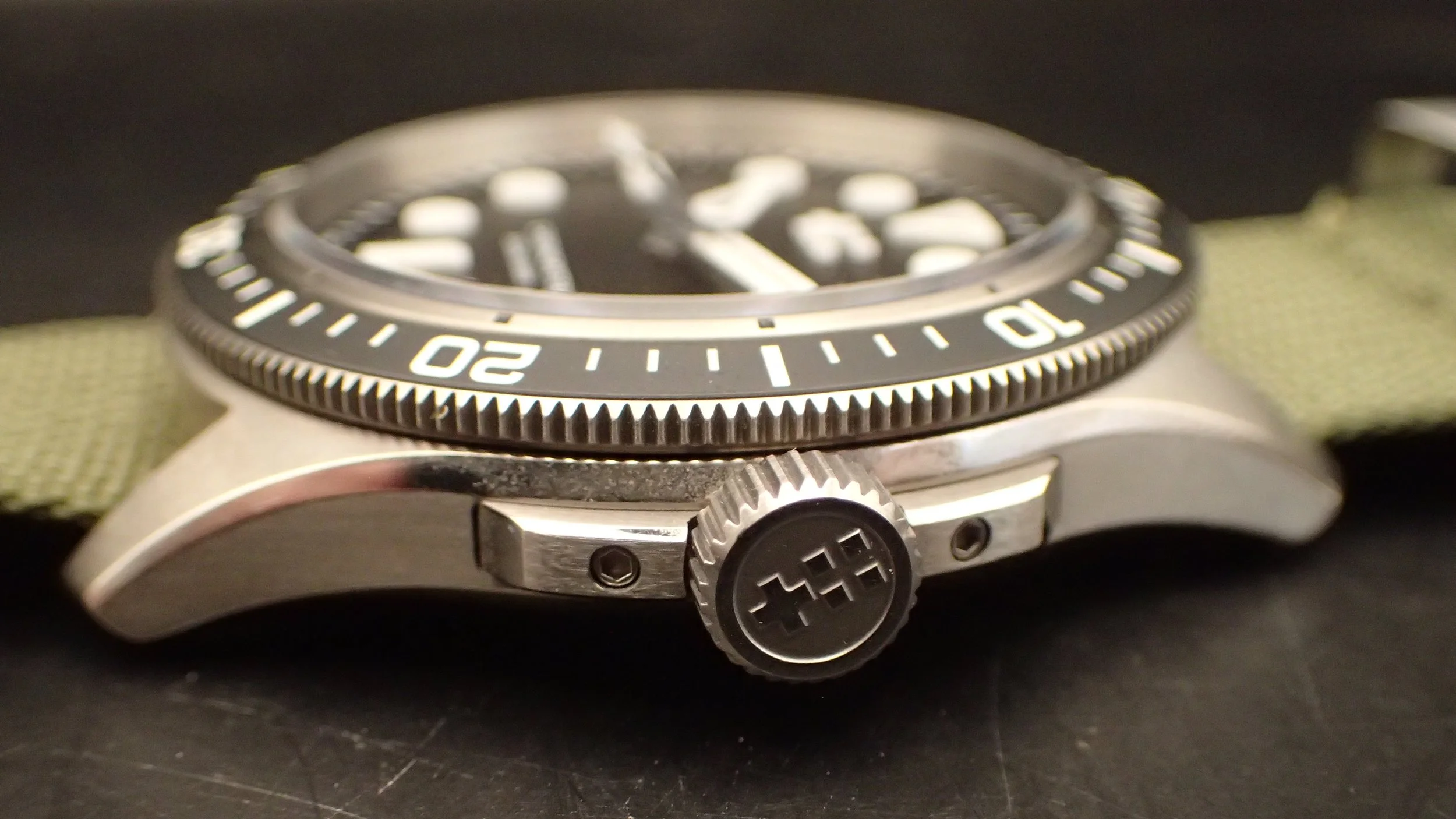
Very cool crown, but I find the screw-on crown guards silly.
Bottom line, even though the Green Fifteen/Lumiére has two things you don’t need, it still crushes it in every other regard and easily earns Ultimate Tool Watch status.
The Specs, Side by Side.
I doubt very much that anyone is ever going to cross-shop these two UTW’s. But just in case that one special person is out there wondering, “Hmm, I have about $2.5K to spend on my UTW, and I can’t decide between a so-called pilot’s watch and a so-called diver’s watch…”, I have assembled the Laco’s and CW’s specs, side by side. The Green Fifteen is sold out, but since it is functionally identical to the C60 Trident Lumiére, I have based my spec-for-spec comparison on the Laco Hamburg and the standard Lumiére.
Laco Hamburg Chr. Ward Lumiére
Diameter, mm 43.5 41.0
Length, L2L, mm 49.8 47.9
Thickness, mm 13.6 10.8
Lug Width, mm 20 22
Water Resist, m 200 300
Case Material Stainless Steel, 904L Titanium, Grade 2
Case Finish Dark Gray Sandblasted Brushed Titanium
Bezel Ceramic, fully lumed Ceramic, fully lumed
Movement Sellita SW200-1 (Top) Sellita SW300-1 (COSC)
Antimagnetic 1,000 Gauss N/A
Pointless HRV? Nope Yep
Luminescence SuperLuminova C1 Globolight XP
Crystal Sapphire Sapphire
Price incl Tariffs, USD* $2,531 $2,570
Factory Warranty 2 years 5 years
*Assuming you order from the factory’s website. Chr. Ward charges state sales tax. See below.
Closing Thoughts. Which Ultimate Tool Watch?
I’m glad I don’t have to choose between these two brilliant Ultimate Tool Watches. But if I were advising a collector friend who did, I’d probably tell him to base the decision on his wrist size, the watches’ respective weights, and whether he wanted a bracelet watch or a strap watch. The Laco weighs as much on its own as the CW weighs with its bracelet, but it looks killer on a shell cordovan strap. The Green Fifteen’s presence is hardly even noticeable when worn on a nylon NATO, and it changes back to the bracelet in a snap.
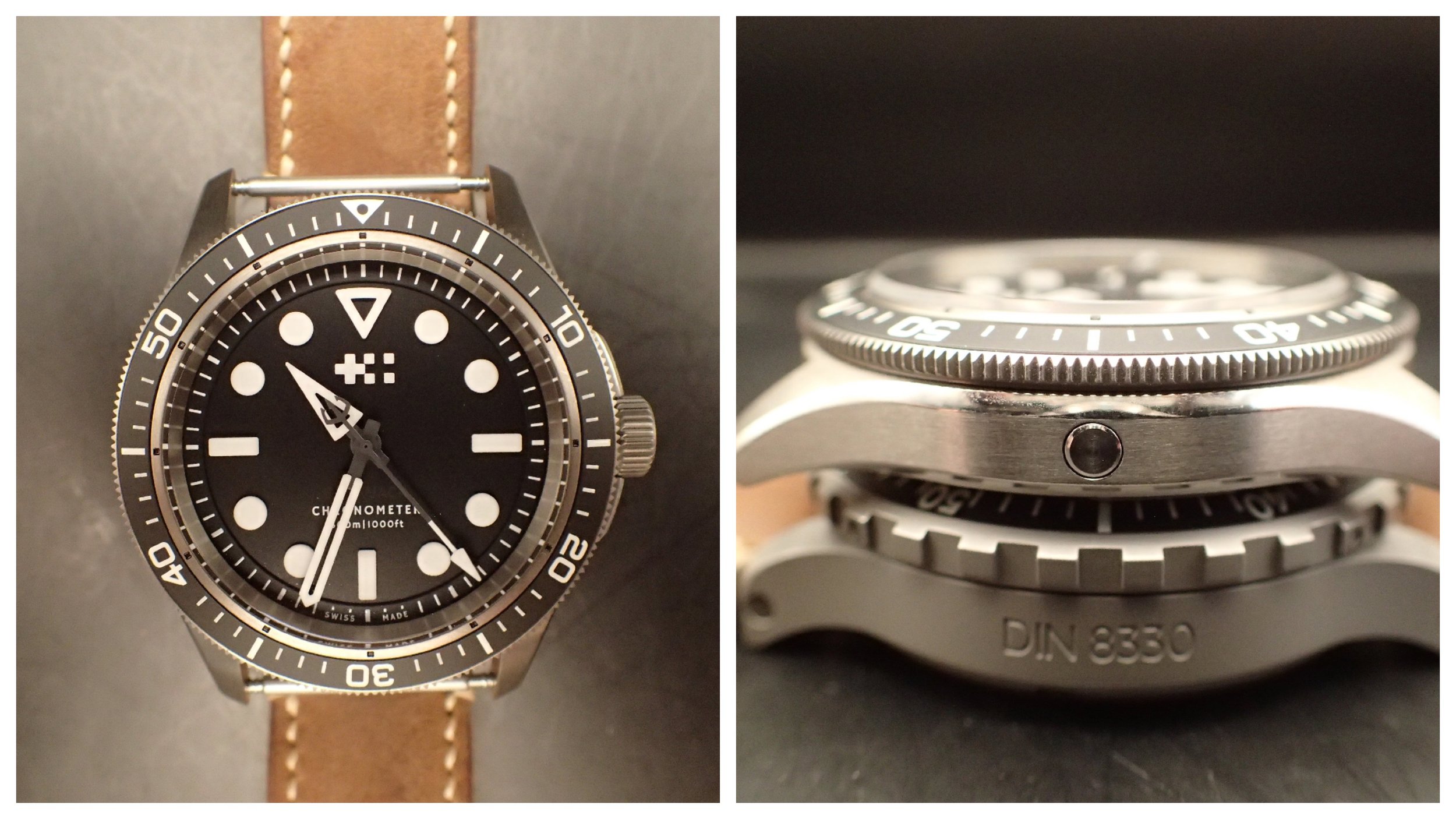
When looking straight down, it’s easy to see why the 43.5 mm Laco wears like a 41 mm watch.
Or our hypothetical collector friend could choose their UTW based on design and legacy. The Laco follows a very traditional design language and comes from a company that’s been around over a hundred years. It is very Form folgt Funktion in its approach. The Green Fifteen presents a fresh, playful personality and comes from a young company that is seemingly expanding like helium in an ascendant dive watch.
Only concerned about the dollars? The prices cited in my spec-for-spec table need some clarification. Laco lists the Hamburg for $2250, and if you order it from the factory shipping is free but you’ll pay $281 in US tariffs, which apparently goes toward making you great again, plus some courier brokerage fee. As Laco has numerous US authorized dealers, I’d order from one of them even if it meant paying shipping. Chr. Ward’s Lumiére is listed at $2570 with free shipping and tariff greatness included, but they will charge your state’s sales tax right out of the gate.
Non-hypothetically, I have recommended both brands to friends and family. One friend ordered a Laco PRO when he asked me what traditional flieger I’d buy, and then a few years later ordered a C65 Sandhurst when he asked me for a recommendation on a good 38 mm field watch. My brother, who had been pondering a Nautilus purchase, saw the Christopher Ward magazine on my coffee table and ordered The Twelve 40 Ti, saving himself about $50K (and my undying judgment) over a second hand Nautilus. Both these guys report loving their watches.
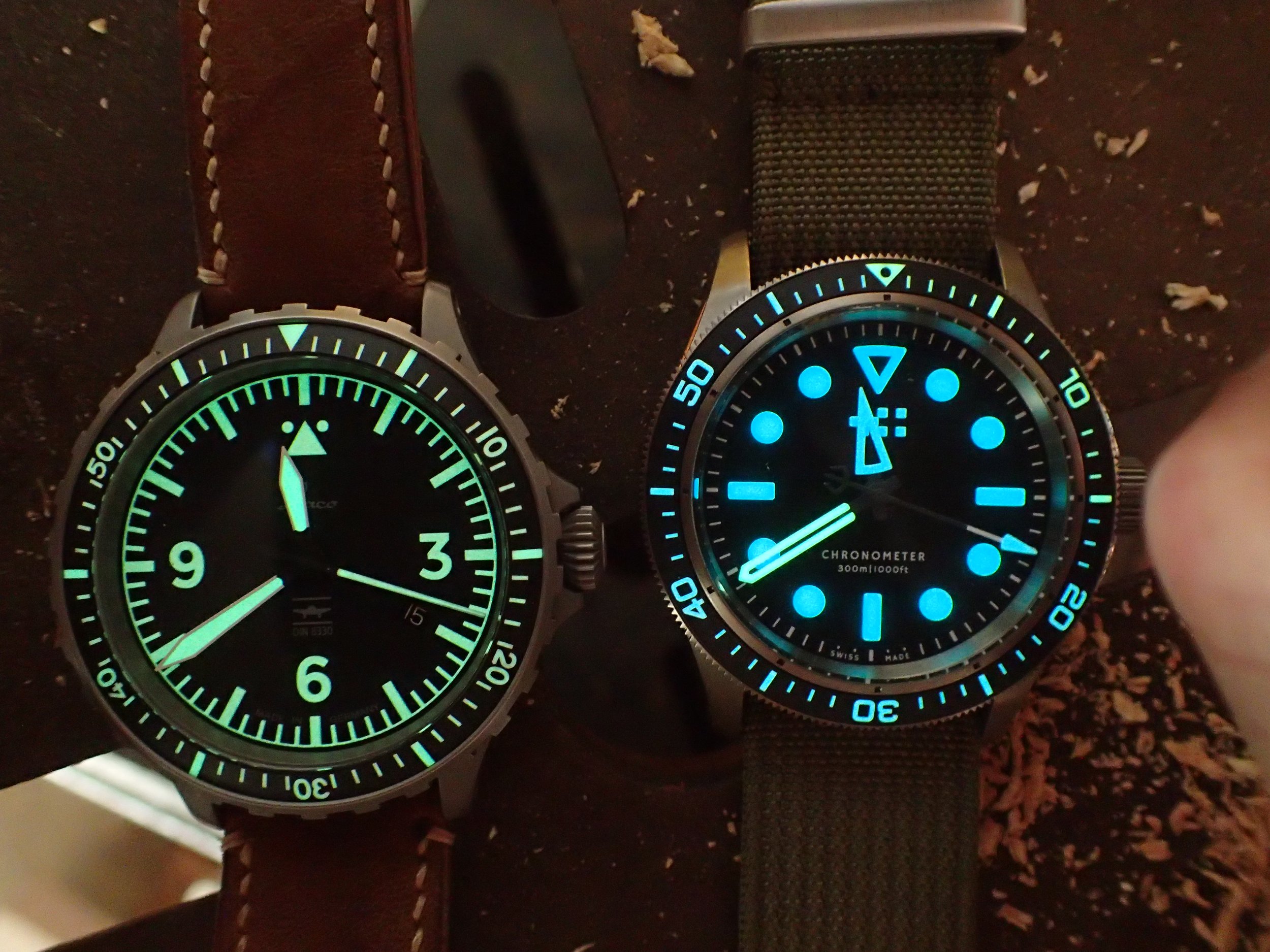
Ultimate Tool Watches.
If my hypothetical friend still couldn’t decide after all this, I’d tell him to look at the company logos on the dial. I have a good friend who looks at Christopher Ward’s twin flags logo and sees only a QR code. Alas, dear reader, for yourself only you can decide.
Thanks for reading my Head-to-Head Ultimate Tool Watch Challenge. I welcome factual corrections, clever observations, your dog’s opinions, etc. in the comments below.